

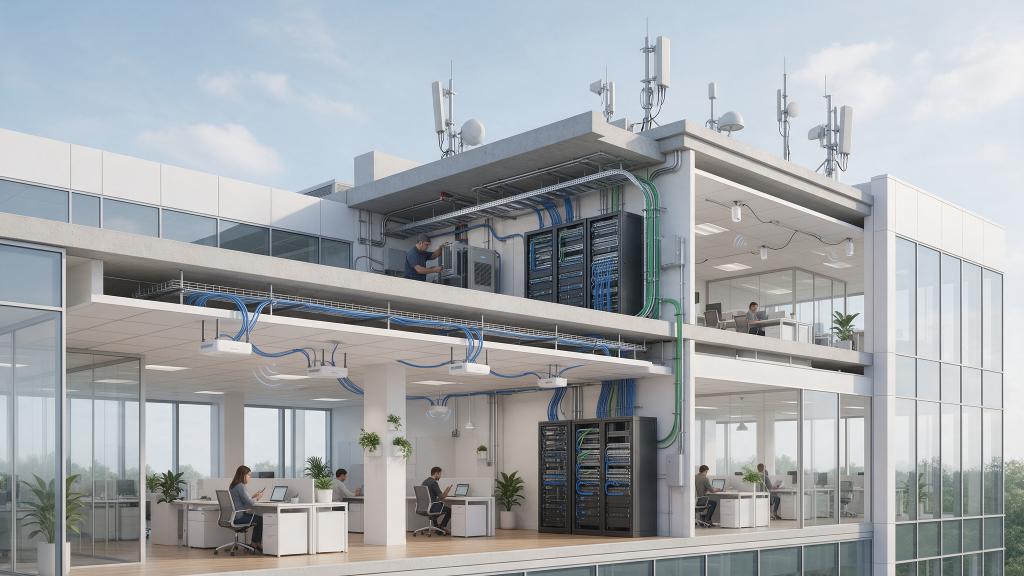
Wireless Still Needs Wires
Wireless technology has transformed how people connect. WiFi connects laptops, phones, scanners, sensors and thousands of other devices, while cellular keeps people and machines connected almost everywhere. Distributed antenna systems and other in-building wireless solutions extend that connectivity into environments where outside signals struggle to reach.
But there is an irony behind all this wireless technology. The user may never see a cable, yet almost every enterprise wireless experience depends on significant physical infrastructure hidden behind walls, above ceilings, inside network rooms and increasingly on rooftops.
People think of WiFi and cellular as technologies that eliminated wires. In reality, we've built an enormous amount of physical infrastructure so the user doesn't have to see the wire anymore.
- Tom Roberto, CTO at SG Network Services
Every Access Point Connects to Something
Enterprise WiFi platforms such as Fortinet may provide sophisticated cloud-managed wireless capabilities, but an access point still requires network connectivity and typically Power over Ethernet. Those connections lead back through structured cabling to network switches, which themselves require power, uplinks and properly designed network rooms before eventually reaching fiber, copper and carrier infrastructure.
The quality of that physical layer matters. Poor wireless performance isn't always a wireless problem. Improper termination, damaged cabling, insufficient PoE capacity or upstream connectivity issues can all affect what the user experiences simply as "bad WiFi." Structured cabling systems from manufacturers such as Leviton Network Solutions are therefore an important part of a wireless environment that users may never physically see.
The line between network infrastructure and wireless infrastructure is disappearing. Cabling, fiber, power, WiFi and cellular increasingly have to be considered as parts of the same connected environment.
- Sandi Rajda, Director, Technical Services at SG Network Services
Cellular Has the Same Physical Reality
Modern buildings can be challenging environments for cellular signals. Concrete, steel, energy-efficient glass and other construction materials can weaken coverage inside a facility, creating demand for in-building cellular systems that bring carrier connectivity closer to the people and devices that need it. Solutions such as Nextivity CEL-FI QUATRA use active DAS technology to address that problem in enterprise environments.
The architecture behind these systems demonstrates how closely wireless and wired infrastructure have converged. Nextivity's CEL-FI QUATRA EVO, for example, can use category cabling for RF distribution and Power over Ethernet while incorporating fiber to extend coverage across larger environments. Improving cellular coverage can therefore involve RF design, antennas, category cabling, fiber and power before the user ever sees another bar appear on a phone.
Survey First. Build Second.
RF environments are difficult to understand from drawings alone. Wireless surveys allow teams to measure what is actually happening inside a facility before determining access-point placement, cellular coverage requirements or the infrastructure needed to support either one. Better information creates better designs, and better designs create better installations.
As businesses deploy more mobile devices, IoT systems, cameras, sensors and connected equipment, wireless connectivity will only become more important. So will the physical infrastructure supporting it. At SG Network Services, we work across both sides of that equation: the wireless technologies people interact with and the infrastructure behind them. Wireless may eliminate the cable to the user. It doesn't eliminate the network behind the signal.