

Technology Doesn't Deploy Itself
The technology industry spends a lot of time talking about what is becoming virtual. Cloud computing moved applications out of the server room, SaaS moved software out of the box, and AI is changing how businesses process information and automate decisions. Yet underneath nearly every digital transformation is something remarkably physical: infrastructure.
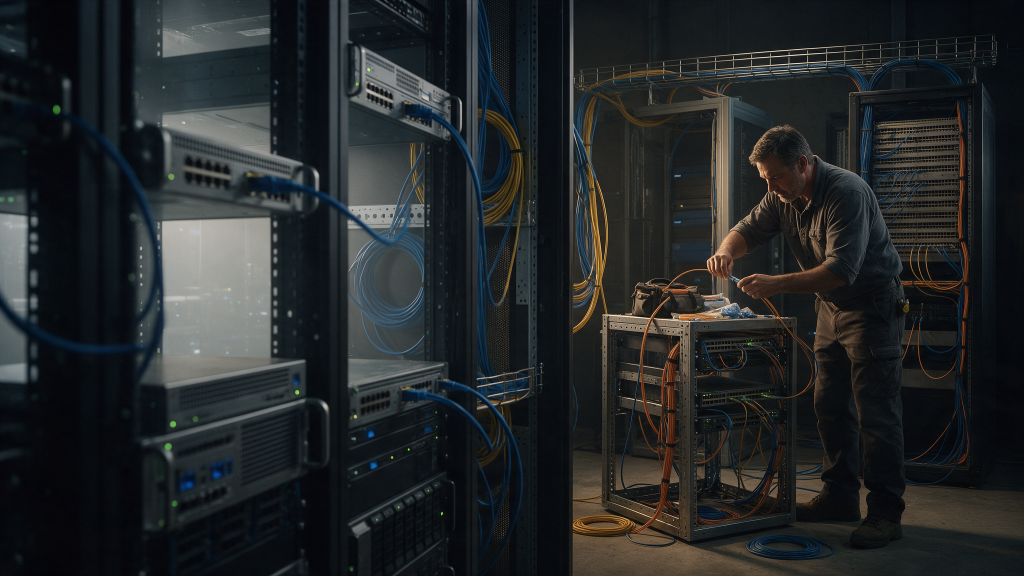
Someone still has to install the router, pull the fiber, mount the access point, power the equipment, connect the edge device and verify that everything works. At SG Network Services, that's where we live: at the point where digital strategy becomes physical reality.
The irony of AI is that something we think of as completely digital is creating an enormous amount of physical work. More compute means more power, more connectivity, more infrastructure and ultimately more people putting that infrastructure in place.
- Tom Roberto, CTO of SG Network Services
The Cloud Has to Get Here Somehow
Enterprises may operate applications and infrastructure in the cloud, but their stores, warehouses, offices, schools, healthcare facilities and datacenters still require connectivity. Cloud-managed platforms such as Cisco Meraki have made it possible to centrally manage networks spread across hundreds or thousands of locations, but every one of those locations still depends on switches, routers, firewalls, wireless infrastructure, structured cabling and power.
The equipment also changes faster than much of the infrastructure supporting it. A switch may be replaced several times while the copper and fiber infrastructure behind it remains in service. Manufacturers such as Leviton Network Solutions continue developing copper and fiber systems capable of supporting increasingly bandwidth-intensive enterprise and datacenter environments. Decisions about pathways, fiber, copper, racks and testing aren't simply installation details. They can determine what an organization is capable of deploying years from now.
Technology keeps becoming more virtual, but the last mile remains incredibly physical. Our job is to make sure the infrastructure underneath all of that innovation actually works in the real world.
- Tommy Mullins, CRO of SG Network Services
AI Is Creating More Physical Infrastructure, Not Less
Artificial intelligence may feel entirely digital, but its growth is increasing demand for datacenters, network capacity, power, edge computing and high-speed connectivity. Companies such as Vertiv are building power, cooling and physical infrastructure specifically around the enormous requirements of modern computing, while enterprise networks are being asked to move more information between datacenters, cloud platforms and increasingly intelligent devices at the edge.
That intelligence is appearing in cameras, sensors, kiosks, digital signage, retail systems, building controls and countless connected devices. Every one eventually becomes a physical deployment project. Equipment has to arrive, sites have to be prepared, infrastructure has to be installed, devices have to be connected and somebody has to support all of it after go-live.The Last Mile of Technology Is Human
Automation can make deployment dramatically better. SG uses technology to coordinate projects, manage field resources, track deliverables and provide visibility across complex programs. But when a technician arrives and discovers that the rack is full, the pathway is blocked, power isn't where the drawing says it is or the equipment shipped doesn't match the scope, software alone doesn't solve the problem.
Experienced people do. The next generation of enterprise technology will be more connected, intelligent and distributed than anything that came before it, but it will still depend on physical infrastructure. From network core and structured cabling to wireless, power, security and edge devices, SG helps enterprises turn technology plans into working technology. Technology doesn't deploy itself. #TeamSG does.